Annual Reports
Adobe Inc.'s annual reports contain management's most considered account of the business. These are the sections, passages and visual pages worth opening in the originals preserved in Sources.
Adobe Inc. — FY2025 Annual Report (Form 10-K) — FY2025 (year ended November 28, 2025)
Latest 10-K; recasts the whole business around AI and pre-announces the FY2026 collapse to a single reportable segment. · Open the full document →
Item 1. Business — p. 4 · Read the full section →
Management's own framing of the mission, the AI-era pivot, and a competitive field now including AI- and cloud-native entrants.
Mission and the AI-era strategy of commercially-safe first-party plus partner models.
Adobe’s mission is to empower everyone to create. We build innovative platforms and tools that unleash creativity, productivity and personalized customer experiences. […] In the artificial intelligence (“AI”) era, we are harnessing the power of AI across our solutions by bringing together our commercially safe first-party and leading partner AI models best suited for the job; deploying conversational and agentic capabilities across offerings; ensuring ubiquity on all surfaces; delivering trusted and secure solutions
p. 4 · Read in context →
How Adobe describes its competitive environment — including new AI or cloud-native entrants.
We participate in a highly competitive and rapidly evolving environment where our competitors include companies of various sizes and both public and private companies, including large, global companies and smaller companies with more specialized focuses, new entrants, and AI or cloud-native companies. […] The markets for our solutions are characterized by rapid technological innovation, new industry standards, evolving distribution and sales models, limited barriers to entry, short product lifecycles, customer price sensitivity, global economic conditions and the frequent entry of new solutions or competitors.
p. 8 · Read in context →
Item 1. Business — Segments — p. 18 · Read the full section →
The structural break: three segments in FY2025, consolidated into one reportable segment effective Q1 FY2026.
Three FY2025 segments — and the coming single-segment reorganization.
In fiscal 2025, our business consisted of three reportable segments: Digital Media, Digital Experience and Publishing and Advertising. […] Effective in the first quarter of fiscal 2026, we will combine our prior segments—Digital Media, Digital Experience and Publishing and Advertising—into a single operating and reportable segment due to changes in how management intends to evaluate results, allocate resources and execute the strategic opportunities outlined above.
p. 18 · Read in context →
Item 1A. Risk Factors — p. 28 · Read the full section →
The two risks specific to Adobe's moment: keeping pace with AI, and the liability of building and shipping AI itself.
Item 7. MD&A — Results of Operations — p. 56 · Read the full section →
Management explains fiscal 2025: subscription-led growth across both major offerings, with the revenue mix now ~96% subscription.
What drove fiscal 2025 — AI-powered differentiation feeding software-based subscription growth.
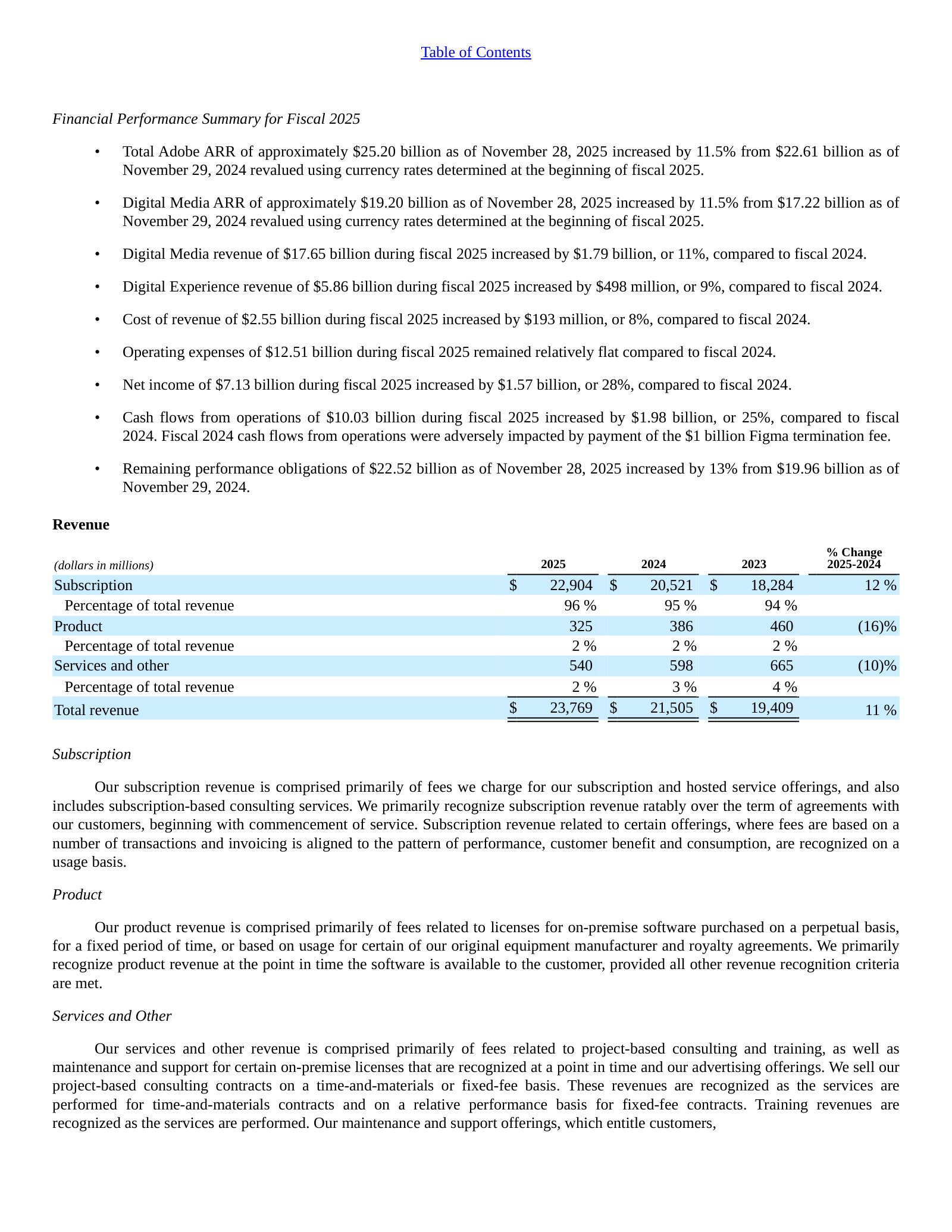
For our fiscal 2025, we experienced strong demand across our Digital Media and Digital Experience offerings, driven by transformative and customer-focused product innovation. As we execute on our long-term growth initiatives, with emphasis on delivering value through AI-powered and highly differentiated solutions to meet the needs of our diverse and expanding customer base, we have continued to experience growth in software-based subscription revenue across our portfolio of offerings.
p. 56 · Read in context →
Item 7. MD&A — Segment Information — p. 61 · Read the full section →
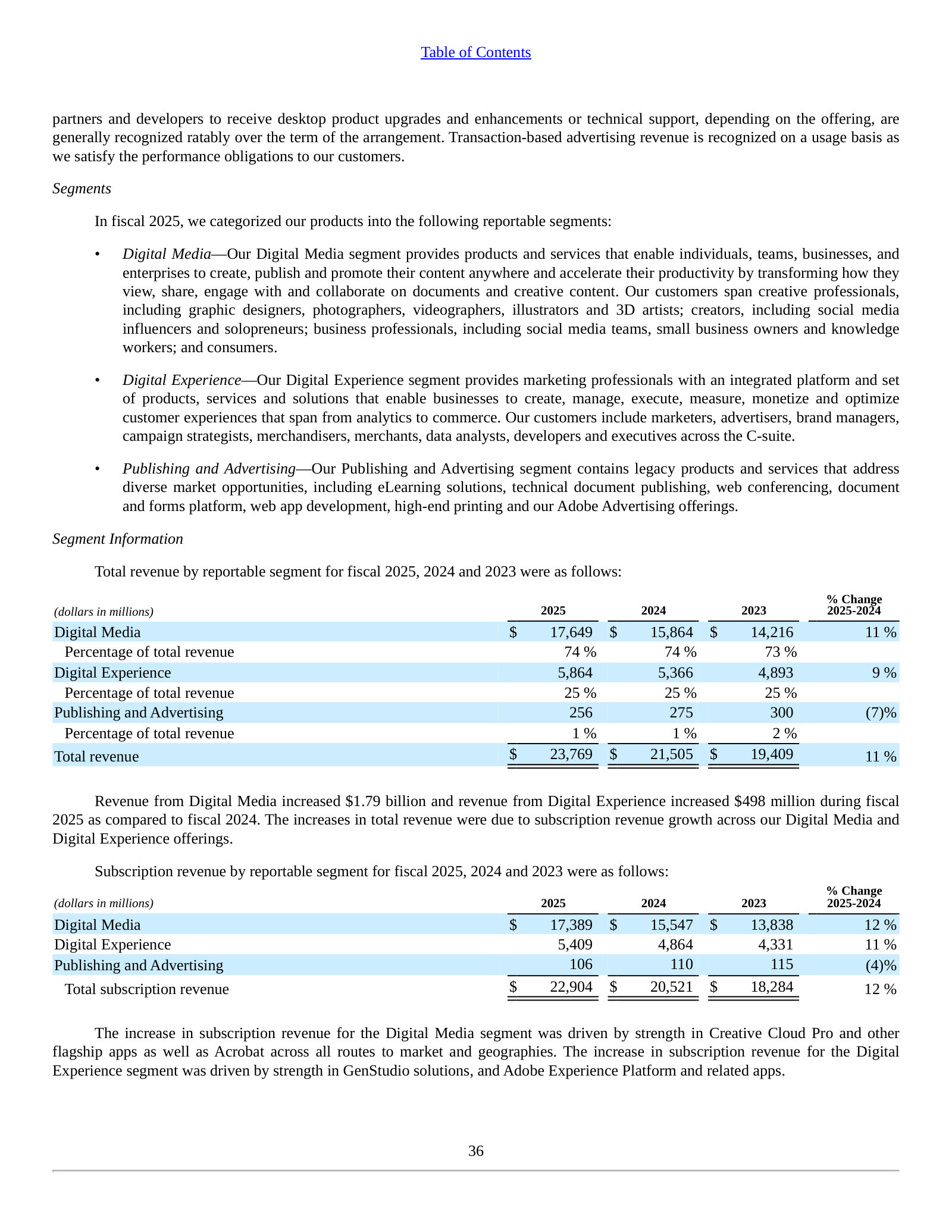
The segment revenue table and what management credits for the growth — Creative Cloud Pro, Acrobat, and GenStudio.
Named growth drivers for Digital Media subscription revenue.
The increase in subscription revenue for the Digital Media segment was driven by strength in Creative Cloud Pro and other flagship apps as well as Acrobat across all routes to market and geographies.
p. 61 · Read in context →
Note 1. Significant Accounting Policies — Revenue Recognition — p. 86 · Read the full section →
The accounting policy that defines the SaaS model: subscription and hosted revenue recognized ratably over the service term.
How Adobe recognizes hosted/subscription revenue — ratably over the contractual term.
Fully hosted subscription services (“SaaS”) allow customers to access hosted software during the contractual term without taking possession of the software. […] We recognize revenue ratably over the contractual service term, which typically ranges from 1 to 36 months, for hosted services that are priced based on a committed number of transactions where the delivery and consumption of the benefit of the services occur evenly over time, beginning on the date the services associated with the committed transactions are first made available to the customer and continuing through the end of the contractual service term.
p. 86 · Read in context →
More annual reports
Adobe Inc. — FY2024 Annual Report (Form 10-K) — FY2024 (year ended November 29, 2024) · 157 pages · Last full year on the classic three-segment reporting; Firefly ramping and the terminated Figma deal ($1.0B fee) behind it. · Open →
Adobe Inc. — FY2023 Annual Report (Form 10-K) — FY2023 (year ended December 1, 2023) · 157 pages · First 10-K to introduce Firefly generative AI, filed as the $20B Figma acquisition was being abandoned. · Open →
Adobe Inc. — FY2022 Annual Report (Form 10-K) — FY2022 (year ended December 2, 2022) · 164 pages · Announces the (later terminated) Figma acquisition agreement — a pre-generative-AI snapshot of the strategy. · Open →
Adobe Inc. — FY2021 Annual Report (Form 10-K) — FY2021 (year ended December 3, 2021) · 163 pages · Pre-Firefly, pre-Figma baseline of the Digital Media / Digital Experience subscription model. · Open →